The idea
Keep a stable taste snapshot. Update a small sticky-note memory on each like or dislike. Do not re-read the whole history.
How they move
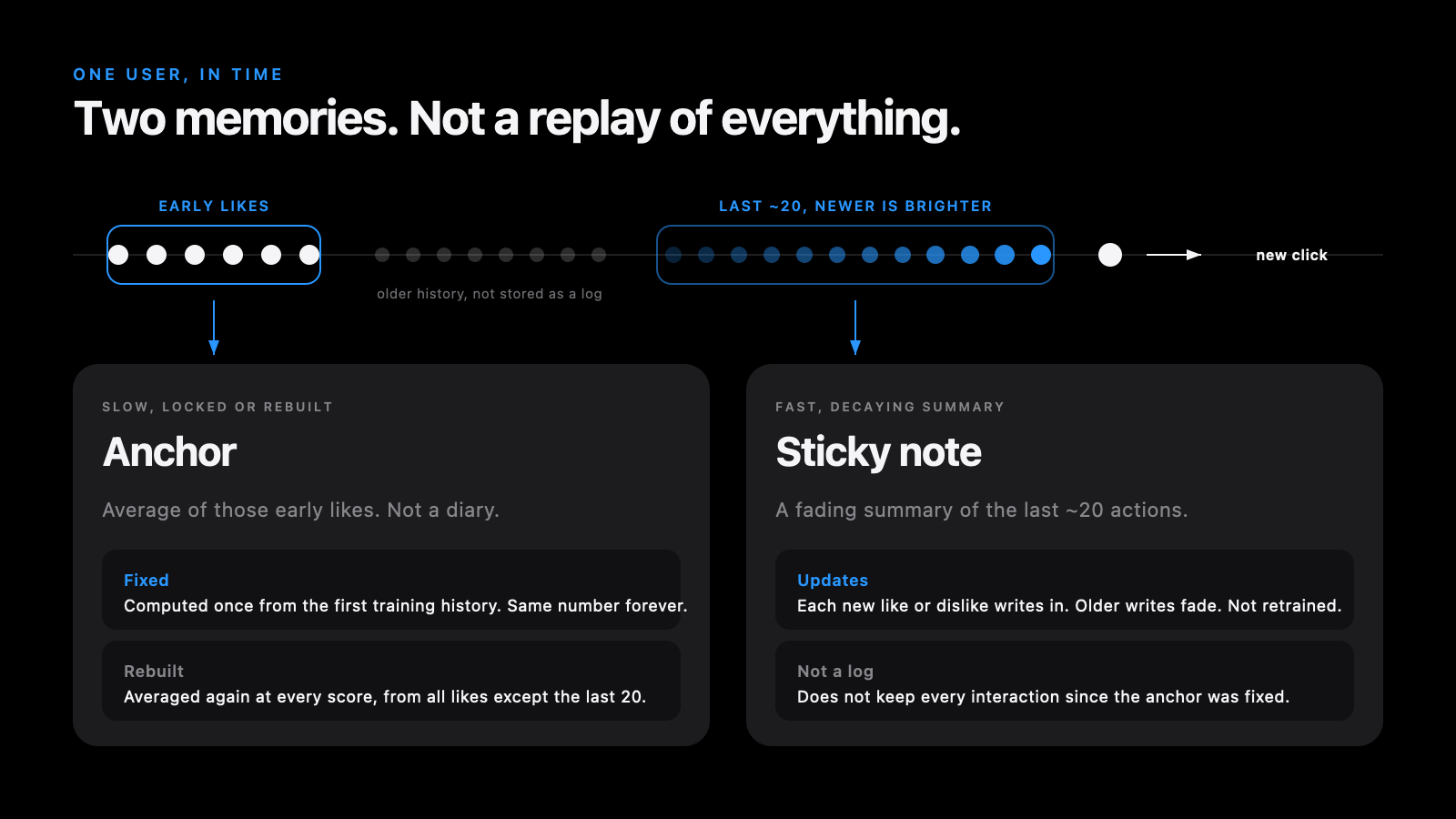
Fixed locks the early-like average. Rebuilt averages again at every score from all likes except the last 20. The note is a fading summary of those last 20, not a log of everything since the anchor.
What it is

Recommenders — what to watch, buy, or read next — have to track what you like now. Most systems re-read your whole history for every new recommendation. Slow and expensive.
FWPRec keeps two things instead.
Anchor
A snapshot of general taste. A saved profile. It stays put.
Sticky note
Updates on each like or dislike. No retraining. Mood, not personality.
Personality stays. Mood shifts with the last few actions. The update is simple math, not a full re-learn.
What the experiments test
Can anchor plus fast memory match or beat GRU and Transformer recommenders on real data: news clicks, product ratings, video watches.
Is it cheaper or smaller to run than those systems.
Which pieces matter. Does dislike memory help, or only likes. Does the anchor stay fixed, or get rebuilt from history.
Where the idea does not work, not only where it wins.
What we claim

Not the best model everywhere. A narrower efficiency and mechanism trade-off.
Top accuracy on every dataset. It loses to standard sequence models on two of four: MIND news and KuaiRand video.
Smaller or faster than everything. At the same size it uses more memory and compute than a well-tuned GRU.
Bounded updates. It never re-reads the full history to update. Updates are instant and capped. That matters when re-reading is the expensive part.
A conditional accuracy win. On explicit likes and dislikes — Amazon ratings — it beats the others, especially on negative feedback.
A mechanism. Splitting stable taste from a fast recent mood is useful. The runs show which parts carry the gain.
This page is the argument. Guardrails and next steps are on Important things to note. Layout is on the method page. Scores live on the experiment pages.